Home / Technology / SPARC
The AI-native Biostatistics Computing Environment
AI-driven biometrics in a governed, audit-ready environment.
SPARC is K3's AI-native biostatistics computing environment. Its AI reads your analysis plan, drafts ADaM specifications, and generates validated programming — all inside enforced rails: role-based access, version control, and a validated Dev → QA → Prod pipeline, so every result arrives reproducible, attributable, and audit-ready.
SPARC pairs AI that does the production work with a computing environment that makes its output trustworthy. The AI reads the analysis plan, drafts specifications, and writes the programs; the environment enforces who can act, versions every change, and gates every release. Speed comes from the AI — audit-readiness comes from the rails around it.
In a GxP setting, a statistical result is only as trustworthy as the environment that produced it. SPARC treats access, change, and release as first-class, enforced controls rather than conventions — least-privilege roles scoped per study and environment, every program and specification versioned as code, and production release gated behind independent QC and electronic signature. Governance is the product, not the paperwork.
Statistical programming timelines are rarely limited by statistics. They are limited by production — writing, validating, and re-writing the programs that turn collected data into analysis datasets and displays, then doing it again after every specification change. SPARC industrializes that production step.
SPARC ingests the SAP as a document, parses it into structured TLF shells, and holds ADaM specifications as versioned, validated objects rather than spreadsheets on a shared drive. Its AI drafts those specifications and generates the analysis code; SPARC then executes it, checks conformance against CDISC rules, and records how every output was produced — all within the governed environment, never outside it.
Programming teams work in their own workspaces and promote work through QA to Production — every save is a commit, every promotion is recorded, and the production environment is the only one that can be exported.
How it works
From the analysis plan to a validated display
The plan and the standards are inputs. Every stage below records what it produced and why, so an output can always be traced back to the sentence in the SAP that required it.
Promotion between workspaces is recorded as an auditable event; only Production can be exported, and export requires an electronic signature.
What it does
SAP ingestion
Analysis plans are parsed from PDF into hierarchical sections, indexed for retrieval, and mapped into TLF shells — so the plan and the outputs stay connected instead of drifting apart.
ADaM specifications
Specifications authored or AI-drafted with value-level metadata, codelists, variable groups, and derivations; validated against reference standards and promoted between workspaces.
Code generation
Composable generators build the analysis program — libraries, datasets, subsets, titles, analysis sets, column templates, exports — with a planning step ahead of code and an LLM assist where it helps.
Execution
R and SAS 9.4 execution services produce RTF tables, listings, and figures. Python is supported alongside them.
Analysis objects
Analysis sets, analysis groups, and data subsets are first-class — a safety population or TEAE subset is defined once and reused across displays.
Error remediation
Execution failures are logged, matched against previously resolved errors, and returned with suggested fixes rather than a raw traceback.
CoCreate
A pair-programming workspace: chat alongside the editor with per-change accept/reject on a diff, so the programmer stays in control of what lands.
Lineage
Variable-level lineage from SDTM through ADaM to each display, with origin and computation method, rendered as a navigable graph.
Dashboards
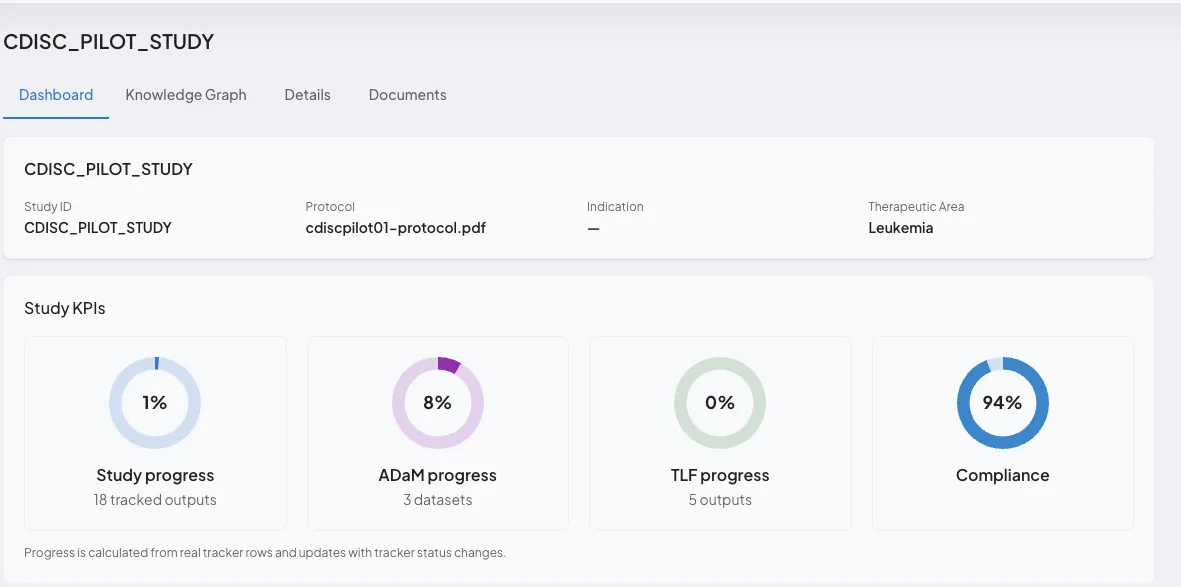
An interactive visual lens over the governed environment — patient profile, safety, efficacy, adverse events, and laboratory modules explored without code, from a study-level overview down to the individual patient. Configurable per study and extensible for organization-specific analytics.
Where it's used
Rescue biometrics
Regenerated ADaM datasets and TLFs for a stalled Phase III in days, with lineage back to the SAP. Biostatistics & Statistical Programming →
FSP acceleration
The engine behind accelerated statistical programming on standing biometrics engagements. Biostatistics & Statistical Programming →
Licensed in-house
Run by a sponsor's own programming team, with onboarding from the people who built it.
Governance & compliance
- CDISC conformance — validation against ADaMIG, SDTMIG, and SENDIG rule sets through the CDISC CORE rules engine
- Version control — every program save is a commit; each study has its own repository with a branch per workspace
- Controlled promotion — private workspaces to QA to Production, with promotion recorded as an auditable event
- Audit trail — an append-only log of commits, promotions, specification publications, and exports
- Electronic signature — production export requires a signed, fail-closed re-authentication with a recorded meaning
- Reproducibility — change detection by content hash, so regeneration is deliberate and traceable rather than wholesale
- Access control — role-based permissions with per-artifact programmer and validator assignments, isolated per organization
Submission-ready output
Datasets and displays conform to CDISC and trace back to your analysis plan — built for the reviewer who reads them.
Months of programming, in days
The production work that sets a biometrics timeline is industrialized, so senior statisticians spend their hours on judgment, not re-runs.
Reproducible under audit
Every result records who produced it, when, and from what — regeneration is deliberate and traceable, not a mystery six months later.
See SPARC on your own scenario.
An hour with the team that built and operates it — on a study shape you recognize. Never a requirement of working with K3, always an option.
Contact K3