Home / Technology / Command Center
Program Delivery & Portfolio Operations
Every program, deliverable, and risk — before it reaches your timeline.
The operating system K3 runs its own delivery on: studies and deliverables through QC, milestones, risks, budgets, timesheets, and governance in one live picture your team can share.
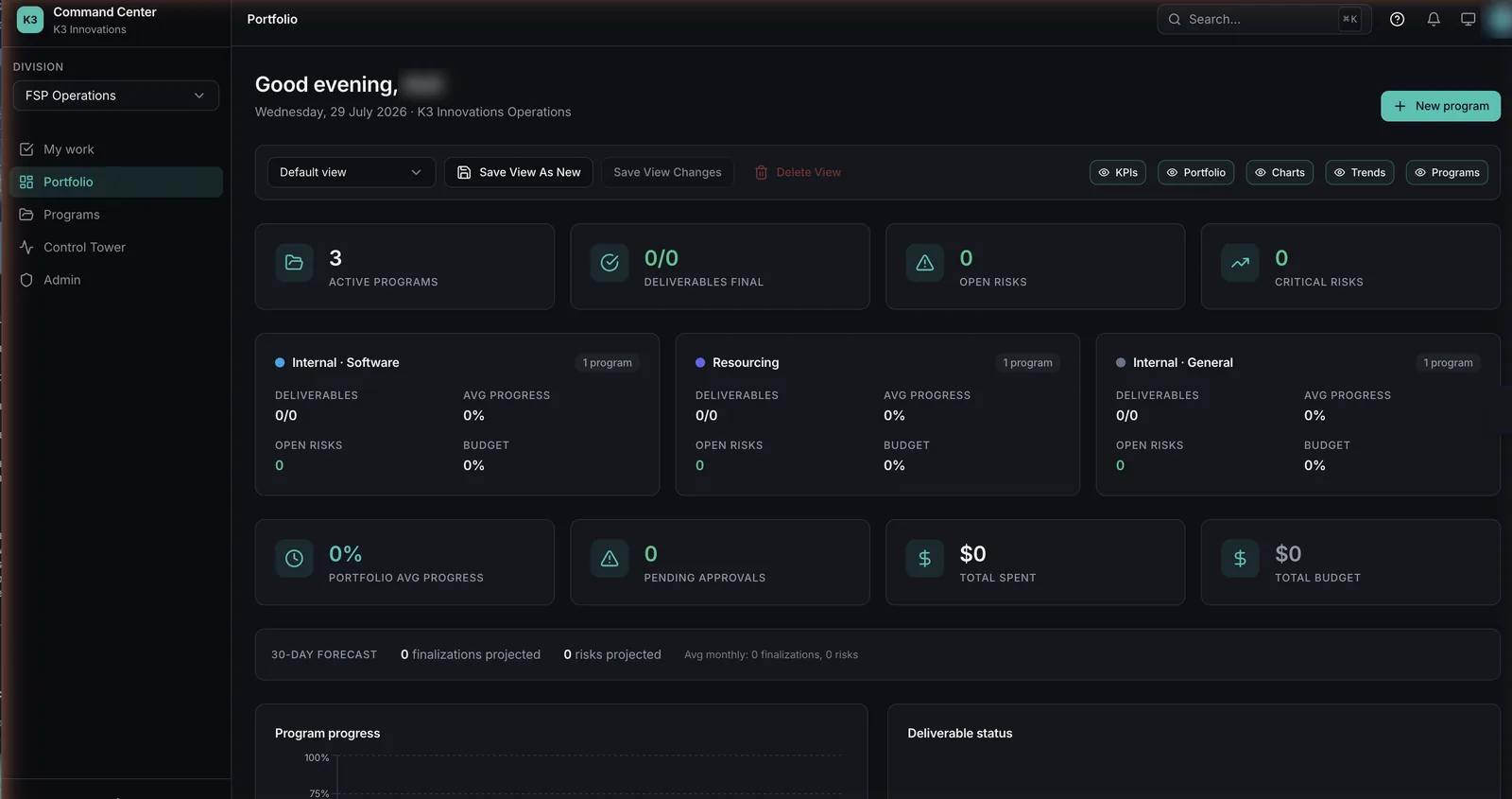
Most delivery problems are visible in the data weeks before they are visible in a status meeting. Command Center exists to close that gap. It tracks the full delivery chain — studies, deliverables, quality control, milestones, risk, and cost — and surfaces the exceptions rather than waiting for someone to assemble a slide.
It is built around the way clinical work is actually contracted: every program carries its delivery model, and the system adapts to it. An FSP engagement, a fixed-scope project, and a resourcing placement each get different views, different service levels, and different metrics.
For sponsors on a K3 engagement, the value is symmetry — delivery status, open risks, and upcoming milestones are the same records our delivery leadership works from, not a client-facing summary produced after the fact.
What it does
Delivery chain
Studies to deliverables — SDTM, ADaM, TLF, narratives, ISS and ISE — each moving through layered QC records and into governance reporting.
Milestones & scope
Milestone tracking with dependencies, task execution on a Kanban board, sprints, releases, and a maintained backlog.
Risk register
Risks scored by probability and impact, tracked to resolution, with automated daily checks flagging critical scores and overdue items.
Budget & contracts
Contract value, forecasts, and cost-versus-contract views giving revenue and margin per program.
Timesheets
Draft, submitted, and approved states with service-level tracking — and variants that reflect FSP versus resourcing realities.
Resourcing chain
Requisitions to placements to timesheets to cost, alongside resource allocation, team capacity, and recruiting metrics.
Governance engine
Approval chains with delegation and multi-level escalation, approval policies, scheduled reports, and governance meeting records.
Portfolio review
A recurring operating cycle that computes metric snapshots and exceptions — service-level breaches, missing submissions, aging deliverables — for weekly and monthly review.
Where it's used
Portfolio oversight
Live delivery status across a multi-study FSP, shared with the sponsor. Clinical Resourcing & FSP →
Risk before timeline
Early risk flags feeding monitoring and site management. Site Monitoring & Management →
Governance
The shared picture a governance meeting starts from, not a slide rebuild.
Where AI assists
Advisory only — every output is reviewed by the person accountable for it before it goes anywhere.
- Delivery-risk prediction across the program's live data
- Timesheet anomaly detection
- Assignment suggestions for unowned deliverables
- Drafted governance narratives, reviewed before they reach a sponsor
- Quality-control pattern analysis and team capacity insight
- Natural-language questions over program data
Governance & compliance
- Audit log — every change recorded with before-and-after values, actor, address, and timestamp
- Division-scoped isolation — multi-tenant separation across programs and organizations
- Automated monitoring — scheduled daily checks for milestones due, overdue deliverables, and critical risks
- Exports — multi-tab Excel and PDF exports for governance packs and sponsor reporting
- Operational maturity — health and readiness endpoints, metrics, alerting, documented runbooks, and restore drills
Risk before your timeline
Delivery risk surfaces in the data weeks before a status meeting would show it.
The picture we work from
Your delivery status, open risks, and milestones are our own live records — not a summary assembled after the fact.
Oversight without the wait
Milestones, quality, and cost in one live view your team can open any day, not last quarter.
See Command Center on your own scenario.
An hour with the team that built and operates it — on a study shape you recognize. Never a requirement of working with K3, always an option.
Contact K3