Home / Technology / PK/PD Analytics
Pharmacokinetics · Pharmacodynamics
Population PK/PD in a governed workspace — not a folder of scripts.
Non-compartmental through population modeling, exposure-response, and bioequivalence — every analysis run against the study, versioned, signed, and reproducible.
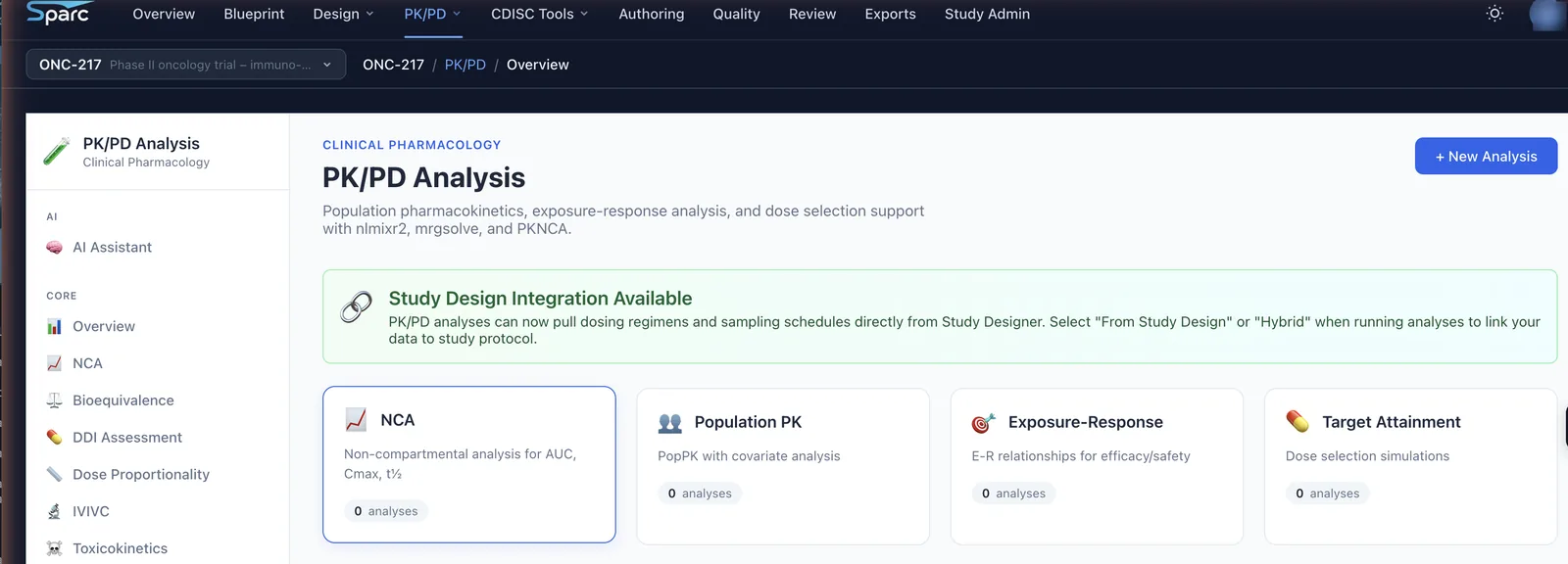
Most pharmacometrics work lives in local installs and personal folders: a NONMEM run here, a WinNonlin project there, results pasted into a report nobody can reproduce six months later. K3's PK/PD workspace puts the same analyses in one governed environment — analyses attach to a study, inputs are recorded, and every result carries the version, seed, and package set that produced it.
The statistics are not reimplemented in-house. Computation runs in a containerised R environment on the established pharmacometrics stack — PKNCA for non-compartmental analysis, nlmixr2 for nonlinear mixed-effects estimation, rxode2 for simulation, PopED for optimal design — with package versions pinned so a rerun a year from now returns the same numbers.
Outputs are built for the people downstream: ADaM ADPC/ADPP datasets, SAS transport files, Define-XML 2.1, NONMEM control streams, and clinical report formats up to CTD Module 2.7.2.
What it does
Non-compartmental analysis
Cmax, Tmax, AUC (last/inf/tau), CL, Vz, Vss, MRT, accumulation and dose-normalised parameters. Linear, log-linear, and mixed trapezoidal methods with automated λz selection. Sparse sampling, urinary, and metabolite workflows included.
Population PK modeling
One-, two-, and three-compartment structures with absorption, elimination, PD, indirect-response, TMDD, and time-to-event models. SAEM and FOCEI estimation, BLQ handling, additive/proportional/combined error.
Covariate selection & comparison
Stepwise covariate modeling with objective-function-based selection; model comparison by OFV, AIC, and BIC.
Diagnostics
Standard goodness-of-fit plots, visual predictive checks, bootstrap confidence intervals, shrinkage and relative standard errors.
Simulation & dose selection
Monte Carlo simulation over virtual populations with inter-individual variability, multi-dose regimens, and target-attainment analysis feeding dose-selection work.
Bioequivalence & DDI
Crossover BE with geometric mean ratios against the 80–125% window, scaled average BE, and drug-interaction assessment with inhibitor/inducer classification.
Exposure-response
Emax, sigmoidal Emax, effect-compartment, indirect-response, and logistic models for binary outcomes, with hysteresis detection.
Specialised analyses
Dose proportionality, IVIVC with Wagner-Nelson and Loo-Riegelman deconvolution, toxicokinetics with exposure multiples, and optimal design via D-optimality.
Where it's used
Submission PK
NCA and population PK for a submission package — reproducible, versioned, signed. Biostatistics & Statistical Programming →
Dose selection
Simulation and exposure-response feeding a dose-finding decision.
Bioequivalence
Crossover BE against the 80–125% window for a filing.
Governance & compliance
- Electronic signatures — password re-authentication with signature hashing and meaning statements, across a five-role approval workflow
- Audit trail — every create, execute, version, approve, and export action recorded with data hashing
- Reproducibility — seeds, R and package versions, and environment fingerprints captured with each run
- Provenance — derivation chains and transformation lineage on a W3C PROV-style model
- Standards output — ADaM ADPC/ADPP, SDTM traceability variables, Define-XML 2.1, SAS XPT
- Conformance checking — a CDISC Rules Engine service validates generated datasets
- Reference datasets — results checked against published values (theophylline, warfarin, ICH M13A)
Filing-grade PK/PD
NCA through population modeling delivered as ADaM, Define-XML, and CTD-ready outputs your submission can use directly.
Reproducible a year later
Seeds, package versions, and environment are pinned to each run, so the numbers hold when a question comes back.
Governed, not a folder of scripts
Every analysis attaches to the study, is electronically signed, and is versioned — no result nobody can reproduce.
Accelerates these services
Biostatistics & Statistical Programming →Preclinical Data Science & Bioinformatics →See PK/PD Analytics on your own scenario.
An hour with the team that built and operates it — on a study shape you recognize. Never a requirement of working with K3, always an option.
Contact K3